Contribute
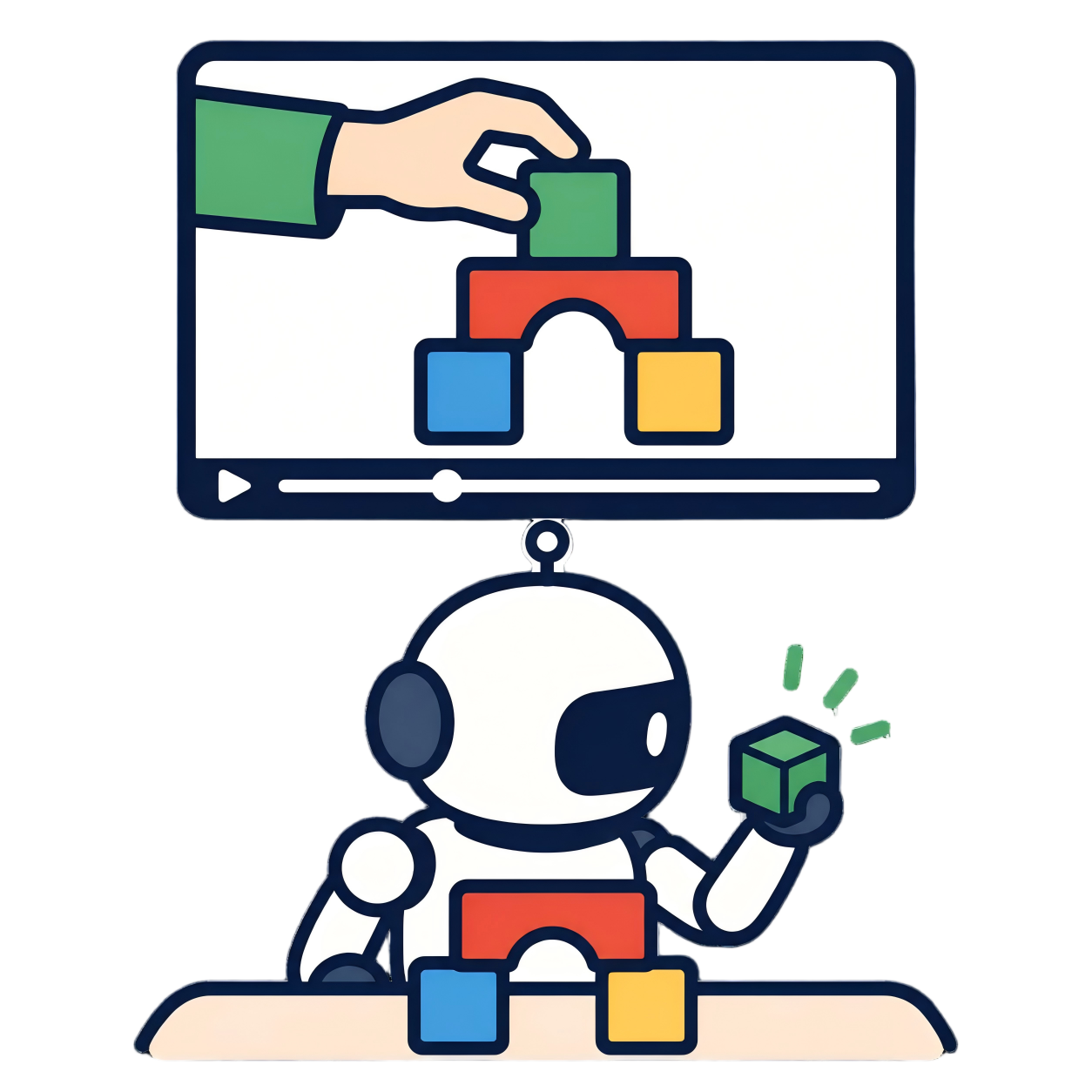
The Imitator Game is an open-source community for robot imitation from human video. Everyone is welcome to contribute tasks, models, embodiments, assets, demonstrations, or evaluation ideas through the shared design templates and reproducible protocols. Discord, WeChat, and the rest of the community channels live on the Community page.
How to grow the benchmark
Anyone interested in imitative ability (goal-directed imitation, video-conditioned policies, cross-embodiment skill transfer, intent inference, affordance adaptation, ...) is welcome to participate. The project grows through four connected contribution paths, all gated by the same design templates and evaluation contracts. Contributions should include enough information for maintainers to reproduce and evaluate them:
Tasks
Contribute new Imitator tasks (L0-L3) designed with the task template under
mani_skill/envs/tasks/_template/, together with their motion-planning
solutions. Accepted tasks can then be added to the benchmark task set, task mapping, and
collection pipeline.
Models
Contribute new imitation-learning models built on the baseline template under
examples/baselines/_template/, together with the evaluation interface and
training/evaluation recipe needed for reproducibility.
Embodiments / assets
Contribute new robots using the robot template under
mani_skill/agents/robots/_template/ and diverse scene assets. New assets
should follow the documented asset pipeline and licensing requirements.
Real-world evaluation
Submit a reproducible model package and simulation environment through the shared protocol. After the simulation package is reviewed, contributors may request deployment on our real-robot platform under the agreed evaluation conditions.
Pairing service
Human demonstration data is only useful for imitation when it is paired with robot trajectories. For accepted community-contributed tasks, we may collect human and robot pairing demonstrations and merge the paired data into IG-10K-format datasets under the shared LeRobot format.
Community members can request pairing for accepted tasks. Pairing is coordinated after the task protocol, reset conditions, and evaluation standard are agreed with maintainers.
Real-device paired data collection
For an accepted task, contributors can provide the human demonstration and task protocol while the project team determines whether matching robot demonstrations can be collected. When available, paired episodes can be released alongside simulated data under the IG-10K / LeRobot contract. See the data collection guide for preparation details and the Task Gallery for published human, simulated, and real-robot rollouts.
Submit a model or simulation environment
We accept more than standalone checkpoints. To request a real-world evaluation, submit a reproducible bundle through a pull request. Include the model checkpoint or source, inference API, environment dependencies, license, task protocol, reset conditions, task-specific evaluation standard, and commands needed to reproduce inference. We first reproduce the simulation result before scheduling hardware time.
Open a pull request with the model or environment package, a short README, the relevant task IDs and L0-L3 levels, checkpoint or asset locations, licensing information, dependencies, and simulator-side evaluation results. Maintainers confirm that the bundle is reproducible before considering real-robot evaluation. The repository does not currently provide an automatic policy-upload endpoint.
Real-world deployment and evaluation
After the simulation package is reproducible and passes review, contributors can request deployment on the real-robot platform. The team runs the agreed evaluation protocol and records rollout videos and evaluation conditions.
Hardware runs are scheduled only after the package is reproducible. Approved real-world rollouts can be added to the Imitator Arena for blind A/B comparison against the same human reference.
Publish results to Imitator Arena
Once a real-world evaluation is complete, we can add the approved rollouts to Imitator Arena. The Arena presents a human reference and anonymous model rollouts for blind A/B human evaluation, turning a private hardware run into a public, community-readable comparison.
The complete path is: submit a reproducible package, reproduce the task in simulation, request real-robot deployment, run the agreed evaluation, and publish approved rollouts to the Imitator Arena. The Gallery keeps the underlying videos discoverable.
Contribution workflow
-
Follow the design templates:
examples/baselines/_template/for models,mani_skill/envs/tasks/_template/for L0-L3 tasks, andmani_skill/agents/robots/_template/for robots. - Open a pull request with your task, model, robot, embodiment, or asset contribution.
- Maintainers review the contribution against the templates (data contract, environment contract, L0-L3 semantics, motion-planning solution).
- Once accepted, the contribution is merged, registered, and, where applicable, considered for human/robot pairing and release.
- For real-world evaluation, provide the reproducible model or source, API, dependencies, license, task protocol, reset conditions, evaluation standard, and simulator results.
- After review, request deployment on the real platform; hardware runs are scheduled only after the package is reproducible.
- Approved real-world rollouts are published in Imitator Arena for blind A/B community evaluation and linked from the Task Gallery.
Active ManiSkill sync
We keep the simulation framework actively updated with the upstream ManiSkill repository so the community can use the latest simulation features. To keep the ecosystem coherent, all contributions must follow the shared ManiSkill design templates — the robot agent template, the environment interface, and the motion-planning interface are the same ones the upstream project documents. If you build on a new ManiSkill feature, please keep the common interfaces intact.
Questions before you open a pull request?
Discord, the WeChat group, direct contact, and the full path from a pull request to a public Arena comparison all live on the Community page — this page stays focused on the templates and contracts a contribution has to satisfy.
See where we talk for Discord and WeChat, and the Community page for the pairing service and the full contribution-to-Arena pipeline. For direct technical inquiries, contact Xunzhe Zhou.
Citation
@misc{zhou2026imitatorgamebenchmarkingrobot,
      title={The Imitator Game: Benchmarking Robot Imitative Ability Beyond Action Prediction},
      author={Xunzhe Zhou and Yiyang Cai and Fengyi Wang and Ran Ju and Hanxiang Ren and Ruizhe Liu and Yu Zhang and Qian Luo and Feng Chen and Pei Zhou and Yi Ma and Yanchao Yang},
      year={2026},
      eprint={2608.22301},
      archivePrefix={arXiv},
      primaryClass={cs.RO},
      url={https://arxiv.org/abs/2608.22301},
}New to the codebase? Follow the installation and quickstart guides, then build your first task with creating a new task.