User Guide
Documentation
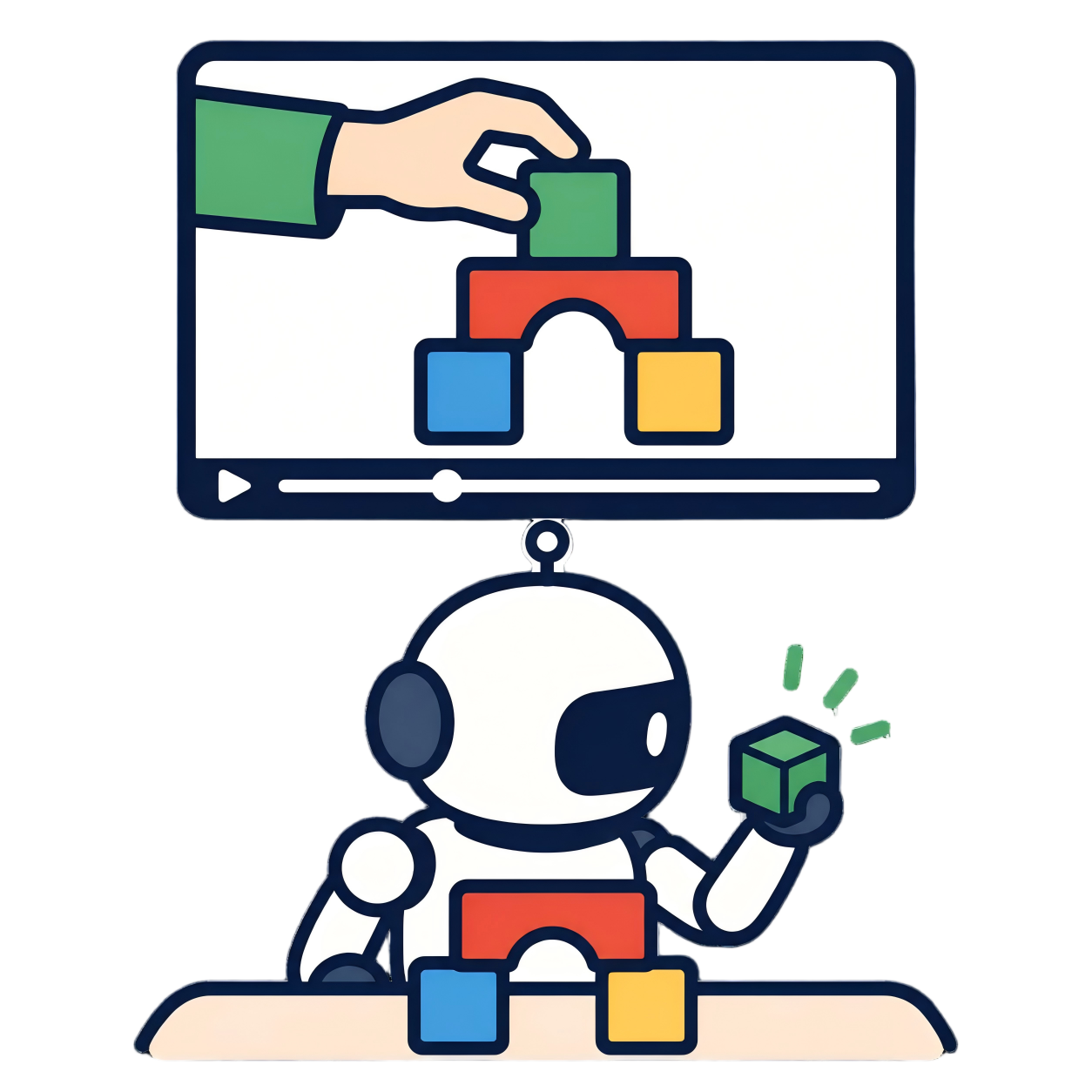
Everything you need to install the benchmark, create and step the dual-arm simulation environments, enable domain randomization, collect paired human–robot demonstrations, and train or evaluate the released baselines.
Get started
Installation
Set up the Python environment with
uv, configure Vulkan rendering,
and download the YCB, RoboTwin, PartNet-Mobility and external GLB scene assets.
Quickstart
Create and step a benchmark environment with
gym.make, switch between
the L0–L3 levels, and run an end-to-end baseline training & evaluation loop.
The four levels L0–L3
Understand the benchmark semantics: trajectory replay, object end-state imitation,
semantic task imitation, and affordance-adapted imitation.
Data
Tutorials
Domain randomization
Randomize the background textures with
random_background=True and
scale object-placement jitter by tuning the xyz[:, :2] += rand * 0.02
offset in your task's _initialize_episode.
Data collection
Generate scripted motion-planning trajectories, batch-collect all 50 tasks at four
levels, and convert H5 demonstrations into LeRobot-format datasets.
Baselines
Train and evaluate ACT, Diffusion Policy, VQ-BeT, UniSkill, XSkill, GR00T, RDT,
π0/π0.5 and OpenVLA on the paired human–robot dataset contract.
Creating a new task
Build new L0–L3 tabletop tasks from the environment template, load YCB / RoboTwin /
PartNet / sketchfab assets, and write a scripted motion-planning solution.
Community
Citation
BibTeX
@unpublished{imitatorgame2026,
      title     = {The Imitator Game: Benchmarking Robot Imitative Ability Beyond Action Prediction},
      author    = {Zhou, Xunzhe and Cai, Yiyang and Wang, Fengyi and Ju, Ran and Ren, Hanxiang and Liu, Ruizhe and Zhang, Yu and Luo, Qian and Chen, Feng and Zhou, Pei and Ma, Yi and Yang, Yanchao},
      url       = {https://github.com/imitator-game/The-Imitator-Game},
      year      = {2026}
    }